A Literacy Strategy for Social Studies Teachers
Those who know me know I love to read. Thankfully, in my work as Thinking Nation’s Director of Curriculum I get to utilize that passion by incorporating curiosity-sparking historical fiction excerpts and engaging scholarly nonfiction sources alongside primary sources.
Over the last several years, I have seen many articles published about the lack of reading that is becoming more prevalent, especially with young people. Recently, The Atlantic called this “The End of Reading.”
While I have many thoughts churning on the accuracy of this label, the data remains clear: American students have significant literacy deficits.
As the back-to-school season approaches, I wanted to share one of my favorite strategies for building students’ reading stamina while keeping them engaged and exposing them to multiple perspectives: Utilizing Historical Fiction
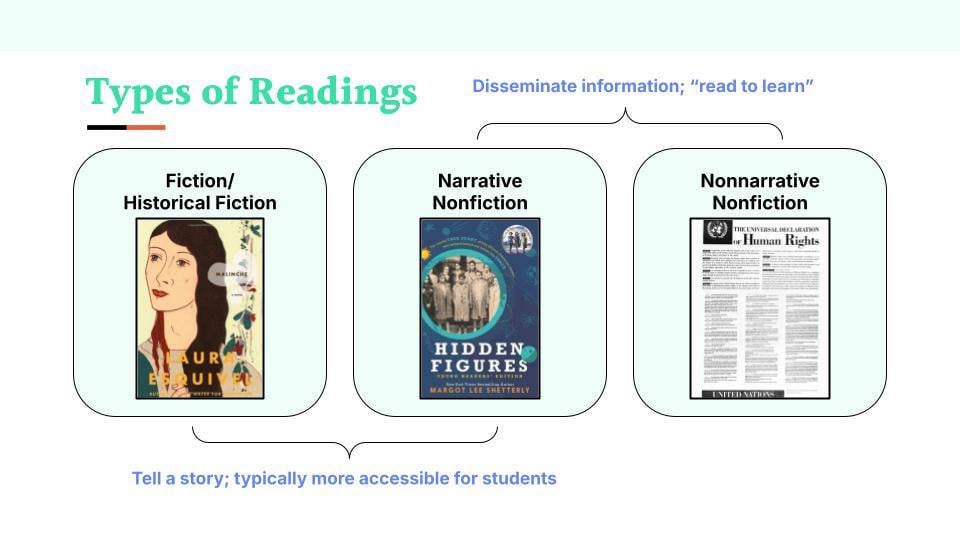
First, take a look at three different types of texts and their purposes:
Start with the Story
Let’s say you want students to read a primary source about the Spanish conquest of Tenochtitlan. You’ll likely reach for a letter by Hernán Cortés. You may show them pictures of the actual letter found through the Library of Congress or an English Translation found through the American Historical Association (Or maybe even Thinking Nation’s formative assessment 🙂).
Primary sources are incredibly valuable. AND for many students jumping into sixteenth-century prose right after summer break can be a big leap.
If we want our students to successfully “read to learn” through a complex nonnarrative nonfiction source, we need to provide them with a “why” for their reading as well as for “why” they should care now.
I have found that by using historical fiction first, those “whys” are sparked.
So instead of starting with a letter by Cortés, let’s dive into something that is written in a way that is a bit more intriguing.
If you don’t know the story of Malinalli (aka La Malinche, Doña Marina, etc), I encourage you to do a quick Google search. You’ll quickly realize that she needs to be taught in both U.S. History and World History. Known as “La Lengua” (The Tongue), she was Cortés’s translator and has a controversial reputation.
In Malinalli by Veronica Chapa, students will be introduced to her role, the challenges resulting by differing languages and cultural practices, and the set up to the conflict surrounding the Spanish siege of Tenochtitlan. I would focus on the chapter “On the Edge of the Precipice” and the ones before and after. Here’s a brief excerpt:
“Every time I appeared before Cortés and Moctezuma, I had to project confidence and calm, no matter what they said, no matter how they behaved. ‘No one else in Tenochtitlan has my skill,’ I reminded myself out loud…”
Build Background
After this interesting start, move on to a narrative nonfiction excerpt. I recommend Conquistadors: A New History of Spanish Discovery and Conquest by Fernando Cervantes. In the chapter “Defeat and Victory,” students will learn that the Spanish were not immediately successful in their conquest. They will learn about the alliances that developed, the impact of disease, and the unique geographic features of Tenochtitlan along with the Cortés’s views. Check out this excerpt:
“The massacre of the Spanish as they fled Tenochtitlan came to be known as the Noche Triste 一 The ‘Night of Sorrows’ 一 when, as every schoolchild is taught in Mexico, on the morning of 1 July 1520, Cortés shed bitter tears under the shelter of an imposing ahuehuetl tree that can still be visited…”
Now, Enter the Primary Source
After this account, bring in the primary source, an excerpt from a letter by Cortés. As students read each source, simply have them fill out a Notice, Wonder, Think chart. Check out tips on this strategy from Thinking Nation’s Best Practice Repository (pdf, video).
To conclude the lesson, facilitate a class debrief. What did we learn from each source? What would we think about the conquest of Tenochtitlan if we only viewed one source? Whose perspectives were included and whose were missing? And then, for the icing on the cake, flip open to their textbook account. It may only be a paragraph or two. Take time to compare the three sources to the textbook. Discuss why textbooks are important and useful and also what their limitations are.
Why This Sequence Works:
What I love about this progression:
- Students are more likely to stay engaged, despite a heavy literacy lesson.
- Students are introduced to a historical fiction that they may seek out on their own after class.
- Students consider multiple perspectives and formats for learning content.
- Students are the investigators, not passive recipients of knowledge.
Finding Great Classroom Texts
When I have given presentations like this at Social Studies Conferences, the biggest question response I receive is, “Well, this is great, but how do I find the sources?” And here is where I see a positive use for AI. Plug in your lesson objective, relevant standards, and then ask for historical fiction, scholarly books, and primary sources that are relevant. Then, use Google Books or your local library to hunt down the texts. Note: I often use AI as a “brainstorming partner” to generate possibilities. However, I always make sure to evaluate each recommendation myself.
Alternatively, feel free to join my book club, the History Solarium. Each month teachers around the country read a Book of the Month and meet to discuss strategies and resources for classroom implementation.
Literacy is Everyone's Responsibility
Literacy is too important to be relegated solely to the ELA department. If we want our students to become stronger readers, we can’t simply ask them to read more. Utilizing creative strategies builds curiosity, engagement, and stamina that students need to make sense of increasingly complex sources.
What texts or strategies have you found most effective for building students' curiosity before introducing primary sources? I'd love to hear your recommendations.
Post a comment